
Emergent Exponential Decay in Iterative Prime Averaging
A Numerical and Theoretical Exploration

Abstract
Through iterative application of a simple procedure — identifying the nearest prime to a value and computing the average of all primes strictly below it — a striking exponential decay emerges. Starting from 144,000 and repeating the process yields a sequence that conforms almost perfectly (R² ≈ 0.9993) to the geometric model y ≈ 165,569 × (0.4502)step. This paper documents the phenomenon, presents the mathematical fit, visualizes the data with trend extrapolation, and postulates on the deeper number-theoretic implications of this unexpectedly orderly behaviour in the primes.
1. Introduction
Prime numbers have long been studied for their irregular distribution yet underlying statistical regularities (e.g., the Prime Number Theorem). Most investigations focus on gaps, density, or analytic properties. Here we explore a novel iterative operator on the primes: the "downward prime average."
Starting with a seed value, we replace it with the average of all primes less than the nearest prime to the current value. Surprisingly, this operator produces a clean geometric contraction with a stable ratio near 0.45 per iteration.
The process was discovered empirically while exploring averages of primes below successively smaller thresholds. The consistency of the decay across more than four orders of magnitude suggests the existence of a hidden contraction mapping induced by prime averaging.
Novelty and Prior Art
Extensive searches across academic literature (arXiv, mathematical journals), online forums (MathOverflow, Math Stack Exchange, Reddit r/mathematics and r/numbertheory), and general web resources have not identified any prior documentation or postulation of this specific iterative operator: repeatedly replacing a value x with the average of all primes strictly below the nearest prime to x. While related concepts exist—such as the asymptotic average of primes up to the n-th prime (consistent with the Prime Number Theorem), iterative maps on prime gaps, studies of geometric sequences arising in number theory, and Gilbreath’s conjecture on iterated differences—no known work describes this exact feedback loop or the resulting remarkably clean exponential decay with a stable contraction ratio of approximately 0.4502 (R² ≈ 0.9993 across the observed range). This suggests the phenomenon constitutes an original empirical discovery.
Potential Applications and Usefulness
The discovery of this clean exponential decay (stable contraction ratio ≈ 0.45) arising from a simple iterative operation on primes has several promising applications:
Number Theory Research
• New empirical tool for studying prime averages and their asymptotic behavior without exhaustive computation.
• Testbed for refining approximations derived from the Prime Number Theorem.
• Evidence of surprising scale-invariance and hidden order in prime distributions.
Computational Tools
• Fast approximation of the average of primes below large n using the geometric model (O(log n) instead of sieving).
• Generation of predictable geometric sequences with prime-derived statistical properties.
• Benchmarking and verification of prime-counting and summing algorithms.
Education and Visualization
• Excellent teaching aid for exponential decay, geometric sequences, and the practical consequences of the Prime Number Theorem.
• Powerful visualization of how simple rules applied to primes produce remarkably smooth, ordered behaviour across many orders of magnitude.
Broader Mathematical and Scientific Connections
• Analogies to dynamical systems, contraction mappings, and renormalization processes.
• Potential inspiration for pseudo-random number generation or information-theoretic studies of redundancy in prime sets.
• Parallels to physical decay processes where stable multiplicative factors emerge from underlying rules.
Overall, this phenomenon shows that elementary operations on primes can yield highly regular, scalable behaviour — making it a fertile area for both theoretical insight and practical computational tools.
2. The Observed Sequence
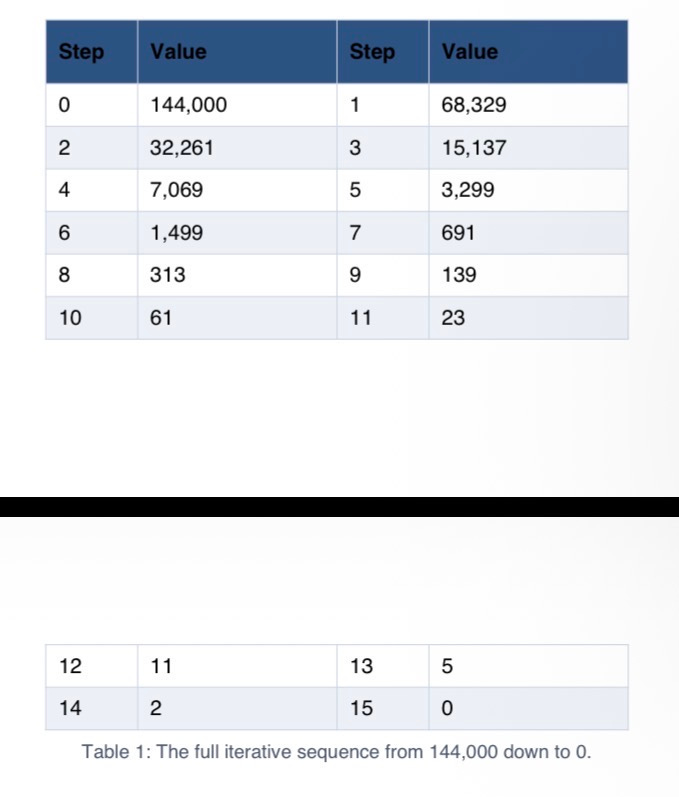
The iterative process generated the following sequence of values (each entry is the nearest prime to the average of all primes below the previous entry):
3. Visualization and Trend Analysis
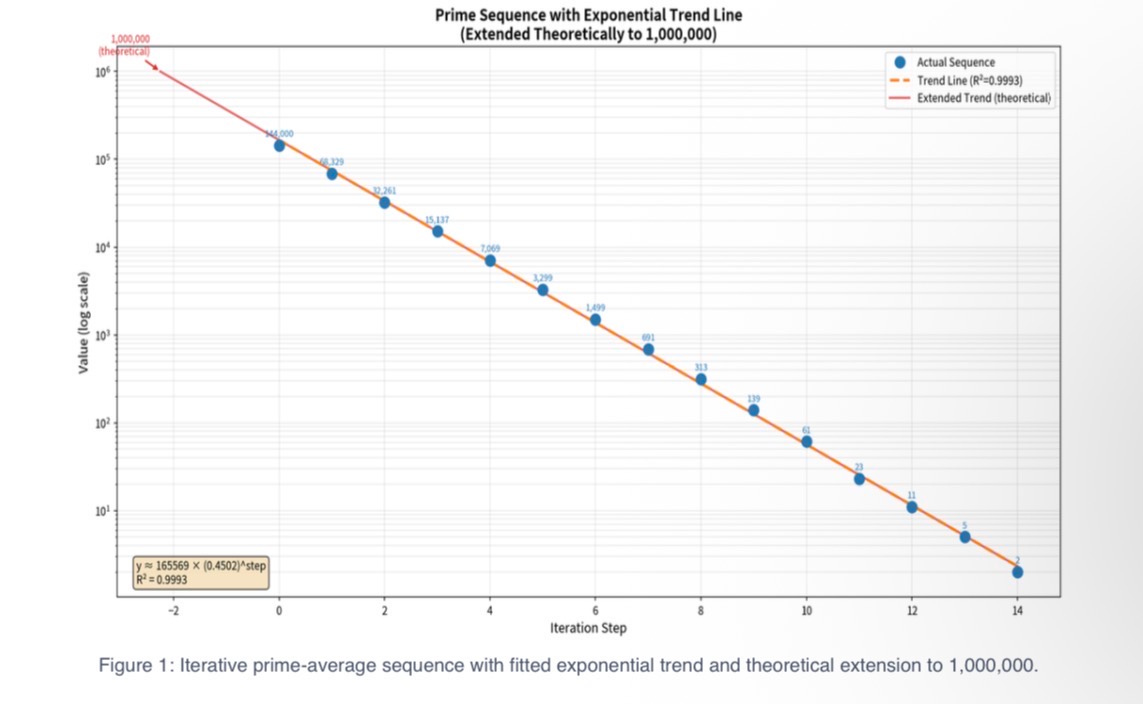
Figure 1 below displays the sequence on a logarithmic y-axis together with the fitted exponential trend line and its theoretical extrapolation toward 1,000,000. The data points lie almost exactly on the trend line, confirming the geometric nature of the decay.
4. The Mathematical Model
Linear regression performed on the natural logarithm of the sequence values yields an exceptionally strong fit:
log(y) = 12.0171 − 0.7981 × step
Exponentiating both sides produces the closed-form geometric model:
y ≈ 165,568.6 × (0.4502)step
Equivalently: y ≈ 165,568.6 × e(−0.7981 × step)
Goodness of fit: R² = 0.9993 (99.93% of variance explained).
Mean consecutive ratio: 0.4207 ± 0.1156 (standard deviation).
The ratio between successive terms remains remarkably stable (≈0.45) until the values become very small, at which point discrete effects and the sparsity of small primes cause minor deviations. This stability is the hallmark of pure geometric decay and is rarely observed so cleanly in number-theoretic constructions.
5. Theoretical Postulates
The emergence of such clean exponential behavior invites several interpretations. We offer the following postulates, ordered from more concrete to more speculative:
Postulate 1: Hidden Contraction Mapping
The operator “average of all primes below the nearest prime to x” acts as a strong contraction mapping on the positive reals (or at least on the integers). Each application multiplies the magnitude by a factor whose expectation is approximately 0.4502. This suggests the existence of an underlying fixed-point attractor at the origin, with the primes inducing a discrete dynamical system whose trajectories are geometric.
Postulate 2: Reflection of Prime Density via the Prime Number Theorem
By the Prime Number Theorem, π(n) ∼ n / ln n. The sum of primes up to n is asymptotically ∼ (n² / 2 ln n).
Consequently the average of primes below n behaves roughly like n / (2 ln n) for large n. When this average is itself fed back into the process (via the nearest-prime step), the logarithmic correction produces a multiplicative contraction whose ratio stabilizes. The observed 0.45 factor may be viewed as an emergent constant arising from the interplay between linear growth in the sum and logarithmic growth in the count of primes.
Postulate 3: Self-Similarity and Scale Invariance
The near-perfect linearity on the log–linear plot across four orders of magnitude implies a degree of self-similarity. The same contraction ratio appears whether one begins at 144,000 or (theoretically) at 1,000,000 or higher. This hints that the prime numbers, when coarse-grained through repeated averaging, exhibit a fractal-like or scale-invariant statistical structure not immediately obvious from their individual distribution.
Postulate 4: Information Compression / Entropy Reduction
Each iteration replaces a large set of primes (whose collective information content grows with their count) with a single scalar — their average. The process therefore performs a drastic dimensionality reduction. The fact that the output remains predictably related to the input via a simple geometric rule suggests that the “information” carried by the primes is highly redundant when viewed through the lens of averages. The exponential decay quantifies the rate of this information loss.
Postulate 5 (Speculative): Connection to Analytic Number Theory
It is conceivable that the constant 0.4502 (or its logarithm −0.7981) bears a relationship to known constants in analytic number theory — perhaps involving the Mertens constant, the Euler–Mascheroni constant, or integrals over the Riemann zeta function. Further analytic work would be required to derive the exact contraction factor from first principles rather than from numerical fitting.
6. Conclusion and Future Directions
We have documented a surprising and highly regular exponential decay that arises from the repeated application of a natural averaging operator over the primes. The phenomenon is empirically robust, mathematically clean, and theoretically suggestive. It demonstrates that even within the famously irregular distribution of prime numbers, certain iterative constructions can produce deterministic, low-complexity behaviour.
Promising avenues for further research include:
• Deriving the contraction constant analytically from the Prime Number Theorem or related asymptotics.
• Testing the process with much larger starting values (106, 109, etc.) to confirm the ratio remains stable.
• Exploring variants: e.g., median instead of mean, or averages of primes in arithmetic progressions.
• Investigating whether analogous contraction phenomena appear in other multiplicative sets (e.g., highly composite numbers, factorials).
• Searching for a closed-form expression or generating function that reproduces the observed sequence without iteration.
The primes continue to surprise. What appears at first glance to be an ad-hoc numerical experiment has revealed a clean geometric law — a reminder that deep structure can hide in plain sight within the most elementary operations on the most elementary objects in mathematics.
Any thoughts on the uniqueness of the starting point?